
Agent's Take: Will Lamar Jackson remain a Raven in 2026? Scenarios to keep star QB in Baltimore
Jackson's future in Baltimore is in question due to his upcoming $74.5 million cap number
By
Joel Corry
•
9 min read
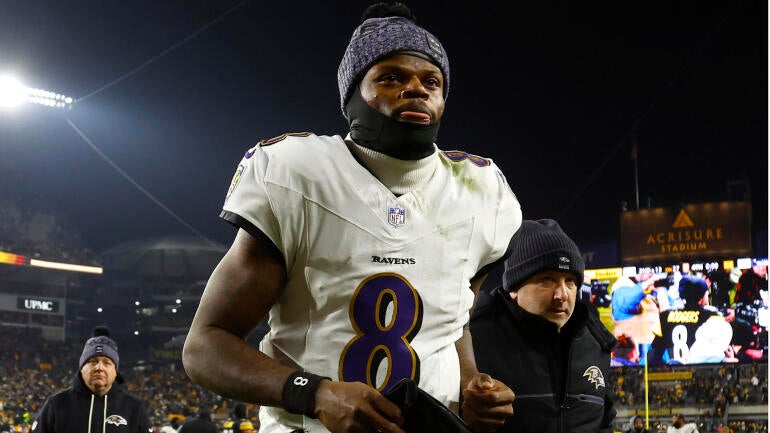
A disappointing Baltimore Ravens season came to end when rookie kicker Tyler Loop missed a 44-yard field versus the Pittsburgh Steelers as time expired with the AFC North title and a playoff berth on the line. The Ravens, who were favorites to win Super Bowl LX before the season started, finished with an 8-9 record which ultimately led to the firing of longtime coach John Harbaugh on Tuesday.
It was also a challenging season for quarterback Lamar Jackson. The two-time NFL MVP's professionalism, work ethic, maturity and relationship with Harbaugh were questioned in a recent article by Baltimore Sun columnist Mike Preston. After a fast start, Jackson was slowed by injuries (hamstring, ankle, toe, knee and back). He missed four games because of the hamstring and back ailments.
The injuries limited Jackson's mobility. He rarely played at an MVP level after the hamstring injury in Week 4 until the fourth quarter against the Steelers when he completed 6 of 8 passes for 172 yards with two touchdowns to have a 156.3 passer rating while the season hung in the balance.
Jackson, who represents himself and has never had an agent, has two years worth $104 million remaining on the five-year, $260 million contract he signed in 2023 after being designated as a franchise player. He is scheduled to make $52 million consisting of a $51.25 million base salary, of which $29 million is fully guaranteed, and a $750,000 workout bonus in 2026. Jackson's 2026 salary cap number is $74.5 million. These figures are the same for Jackson in 2027.
The article and the underwhelming season have raised questions about whether Jackson will be with the Ravens in 2026. Jackson wasn't willing to address his future in Baltimore following the stunning loss to the Steelers.
The Ravens have four options with Jackson: (1) keep his 2026 cap number the same; (2) give him a contract extension; (3) trade him; (4) restructure his contract. Jackson's situation, which will be a top offseason priority, is going to loom over the Ravens until there is a resolution.
Carrying Jackson's 2026 salary cap number
Jackson has 2026's third largest cap number behind Cleveland Browns quarterback Deshaun Watson's $80,716,514 and Kansas City Chiefs quarterback Patrick Mahomes' $78,213,888. The expectation is the Browns and the Chiefs will restructure these contracts to create 2026 cap space.
Keeping Jackson at his $74.5 million cap number would be unprecedented. The largest cap number a team has ever had during the regular season is the Dallas Cowboys with quarterback Dak Prescott at $50,527,250 in 2025. The Ravens would have Jackson at essentially 47.5% more than Prescott by leaving his cap number intact.
A $74.5 million cap number should represent nearly 25% of the 2026 salary cap. The 2025 salary cap is $279.2 million, which is a 9.32% increase from 2024. Similar growth would put the 2026 salary cap in the $300 million to $305 million range. This would be the largest percentage of the league-wide salary cap that a player has taken up dating to 2011 when the lockout ended. Quarterback Jimmy Garoppolo's 20.88% in 2018 with the San Francisco 49ers is the most during this span.
Jackson continuing to have a $74.5 million cap number isn't practical either. The Ravens have $283.083 million of 2026 cap commitments with 48 players under contract using NFLPA data. There's $10.12 million of existing 2025 cap space that can be carried over to the 2026 league year. Under offseason accounting rules, only the top 51 salaries (i.e.; cap numbers) matter. The Ravens should have approximately $286.1 million of 2026 cap commitments with the full complement of players. After factoring in the carryover, the Ravens should have in the neighborhood of $26.5 million of cap room depending upon where the 2026 salary cap is set.
Ravens fire John Harbaugh: Baltimore moves on from Super Bowl-winning coach after 18 seasons
Jordan Dajani

Extending Jackson's contract
The Ravens and Jackson reportedly had preliminary discussions about a new contract during the offseason that were initiated by the organization. A new deal is the most likely outcome given the circumstances. Jackson still has significant contract leverage despite his injury-plagued and subpar season by his standards because of his cap number.
As long as Harbaugh is still around, Jackson should use his words against the Ravens in negotiations. "When Lamar gets paid, he's going to be the highest-paid player in football, just like he was last time. I think every contract he signs till he decides to hang up his cleats, he's going to be that guy," Harbaugh said at the NFL's annual meetings last March.
Prescott is currently the NFL's highest-paid player at $60 million per year. He signed a four-year, $240 million contract extension right before the 2024 regular season started. The deal includes an NFL-record $78,453,333 signing bonus.
It wouldn't be surprising for Jackson to insist that his $52 million-per-year contract should be adjusted for salary cap inflation with a new deal. In a 2026 salary cap environment, that's approximately $70 million per year considering the growth in the salary cap should be between 33% and 36% since Jackson signed in 2023. Jackson could use adjusting Prescott's contract for salary cap inflation as additional justification for $70 million per year. Prescott's deal is in the $71 million-per-year neighborhood when factoring in salary cap growth.
A $70 million-per-year extension would represent a 16.67% increase over Prescott's deal. The biggest increase in the quarterback market from a single deal since the 2011 lockout ended, besides Mahomes' unique 10-year, $450 million extension in 2020, is Aaron Rodgers' final-year contract with the Green Bay Packers in 2022.
Rodgers' three-year, $150.815 million contract, averaging $50,271,667 per year, was 11.71% more than Mahomes' deal. Jackson getting a similar increase over Prescott would put him at $67 million per year.
The Ravens will surely prefer to repeat what was done with Jackson's current contract. His $52 million per year was 1.96% more than the $51 million-per-year extension Philadelphia Eagles quarterback Jalen Hurts received a few weeks earlier. A comparable increase over Prescott's $60 million per year would put Jackson at $61.175 million per year.
Any Jackson extension will likely include a record signing bonus, which was the case in 2023. His $72.5 million was the most ever in an NFL contract eclipsing Prescott's $66 million in his 2021 deal. Upwards to $34 million of 2026 cap space could be created this way. For example, Jackson getting an $85 million signing bonus prorated at $17 million annually from 2026 through 2030 with his $1.3 million league-minimum base salary and the $750,000 workout bonus remaining a part of the deal would lower his 2026 cap number to $41.55 million, which would free up $32.95 million of 2026 cap room.
Trading Jackson
The Ravens can't move Jackson without his consent because he has a no-trade clause. The most likely scenarios for a trade to take place are the Ravens balking at what are viewed as exorbitant contract demands where Jackson requests a trade or him telling the Ravens he wants a change of scenery and intends to leave in 2028 once his contract expires. The Ravens would be powerless to keep Jackson from hitting the open market because his contract contains a clause prohibiting the use of a franchise or transition tag after the 2027 season.
The Ravens will want a king's ransom like the Houston Texans and Seattle Seahawks received, respectively, for Watson and Russell Wilson in 2022. Watson and a 2024 sixth-round pick were dealt to the Cleveland Browns for 2022, 2023 and 2024 first-round picks, a 2022 fourth-round pick, a 2023 third-round pick and a 2024 fourth-round pick. The Denver Broncos acquired Wilson and a 2022 fourth-round pick from the Seahawks for multiple players (tight end Noah Fant, defensive lineman Shelby Harris and quarterback Drew Lock), 2022 and 2023 first-round picks, 2022 and 2023 second-round picks and a 2022 fifth-round pick.
Curiously, no teams reached out to Jackson after the Ravens gave him a non-exclusive franchise for $32.416 million in March 2023. Not wanting to put the time and effort into creating an offer sheet that the Ravens would likely match was a legitimate concern. The two first-round pick draft choice compensation for an unmatched offer sheet being a deterrent was surprising given Jackson is an MVP-caliber quarterback and the acquisition cost of Watson and Wilson.
The worst-case scenario for the Ravens should be receiving Sauce Gardner-type compensation for Jackson. The Indianapolis Colts acquired the All-Pro cornerback from the New York Jets at this season's Nov. 4 trade deadline for a 2026 first-round pick, a 2027 first-round pick and wide receiver Adonai Mitchell.
Presumably, the acquiring team would be working out a new deal with Jackson in connection with the trade or shortly thereafter. It wouldn't make a lot of sense for Jackson to potentially just be a two-year rental after giving up substantial assets to acquire him.
Trades for a starting quarterback typically occur before the NFL Draft, which is April 23-25 this year. Presumably, the Ravens would want 2026 draft capital as a part of any package for Jackson. The acquiring team would want Jackson to have as much time as possible to get acclimated to a new offense and develop chemistry with his wide receivers.
The Ravens would have $57.5 million in 2026 dead money, a salary cap charge for a player no longer on a team's roster, from dealing Jackson in this time frame. The record for dead money related to an individual player in one league year is Wilson's $53 million because of the Broncos releasing him with a post-June 1 designation in March 2024. There would be $57.5 million due to Jackson's contract containing two option bonuses. The seldom-used double-option bonus is one of the more complicated structures with NFL contracts.
An option bonus is essentially an additional signing bonus that's usually paid in the second or third year of a contract to exercise a later year or years in a deal. Since an option bonus is given the same treatment on the salary cap as signing bonus, it is also prorated or evenly spread out over the life of a contract for a maximum of five years.
A $17.5 million payment (i.e.; option bonus) was made in March 2024 to exercise an option for a voiding/dummy 2028 contract year. The $17.5 million was prorated at $3.5 million annually from 2024 through 2028.
A $22.5 million payment was also made last March to pick up a voiding/dummy 2029 contract year. There is $4.5 million of annual proration from 2025 through 2029 with the $22.5 million option bonus.
The $57.5 million in dead money consists of $29 million of 2026 and 2027 proration from Jackson's signing bonus, $10.5 million of 2026 through 2028 proration from the first option bonus and $18 million of 2026 through 2029 proration relating to the second option bonus. Jackson would be off Baltimore's books beginning in 2027.
Restructuring Jackson's contract
A contract restructure could come into play with the two sides being unable to reach an agreement on a new deal where Jackson remains with the Ravens for the 2026 season. The Ravens would create $37,462,500 of 2026 cap room by converting Jackson's entire 2026 compensation minus his league-minimum salary and workout bonus into signing bonus. This $49.95 million would be prorated over Jackson's existing two contract years and the two dummy/voiding years to lower his 2026 cap number to $37,037,500.
Jackson's cap number for 2027, the final real year of his contract, would increase from $74.5 million to $86,987,500. The Ravens would be in the same situation the Cowboys were with Prescott in 2024 because of the provision preventing him from being designated as a franchise or transition player and the no-trade clause. With Jackson having a bounce-back season in 2026, he would have enough leverage to practically name his own price in his 2027 contract extension.